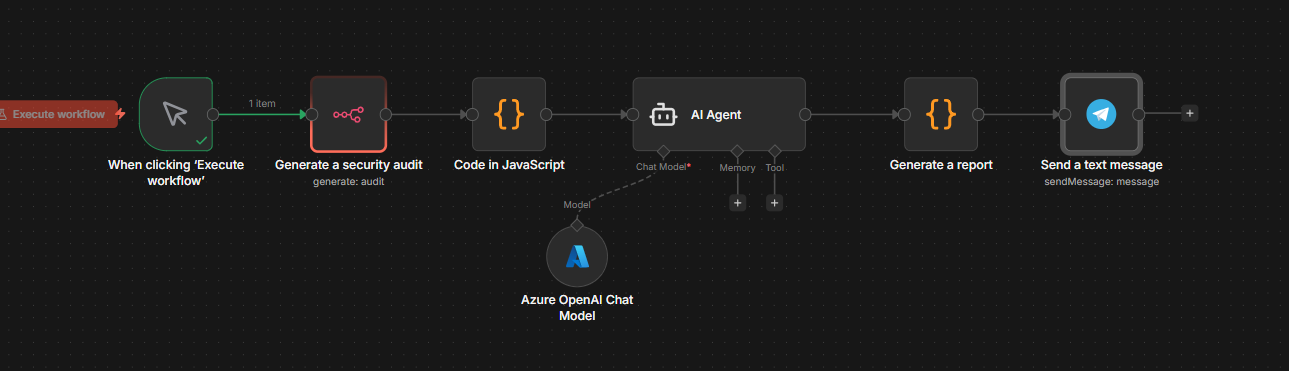
Security audit for n8n instances that identifies real infrastructure risks and delivers AI-filtered reports via Telegram.
The Problem
Cybersecurity companies rely on n8n for critical automation:
- MDR firms: alert triage workflows
- GRC companies: compliance evidence collection
- Cloud Security: misconfiguration detection
- IAM/PAM: access provisioning automation
- Leftover credentials from testing (HIGH risk if compromised)
- Unprotected webhooks allowing unauthorized workflow triggers
- Risky nodes (Execute Command, HTTP Request) with broad permissions
- Filesystem access nodes creating data exfiltration paths
The Solution
Automated weekly security audits with AI-powered false positive filtering:
- Schedule trigger: Runs every Sunday at 3 AM
- n8n audit: Scans database, credentials, filesystem, instance config, nodes
- AI analysis: Claude acts as security analyst, ignores count = 0 findings
- Report delivery: Telegram notification with only actionable items
- Catches unused credentials before they become liabilities
- Detects unprotected webhooks exposing workflows to internet
- Identifies risky nodes (Execute Command, SSH, FTP) for review
- Filters out noise (count = 0) to prevent alert fatigue
- Extracts clean text from AI response (handles structure changes)
Use Cases
For MDR/SOC Automation: Your n8n instance processes customer alerts. An unused credential with SIEM access = backdoor to all customer data. Weekly audits catch this before breach.
For GRC Compliance Automation: You automate SOC 2 evidence collection. An unprotected webhook = anyone can trigger compliance checks and see your control status. Audit detects exposed endpoints.
For Cloud Security Workflows: Your n8n runs CSPM checks across AWS/Azure. A risky Execute Command node with cloud credentials = lateral movement path. Report flags dangerous configurations.
For Offensive Security Infrastructure: Red team uses n8n for attack simulation orchestration. Leftover credentials from old campaigns = OPSEC failure. Automated audit maintains clean operational security.
Business Impact
Time savings: 2 hours/month manual security reviews → 5 min automated Risk reduction: Unused credentials caught in days, not months Compliance: Audit trail for internal automation security posture Scalability: Works across dev/staging/prod n8n instances
Report Categories
Audit covers five critical areas:
- Database: Configuration security, connection risks
- Credentials: Unused credentials (not in workflows, not in active workflows, not in recent workflows)
- Filesystem: Nodes with file system access
- Instance: Global security configuration
- Nodes: Official risky nodes (Execute Command, HTTP Request, SSH, FTP), SQL injection vectors